REVIEW · WASHINGTON DC
National Mall Expedition: Personalized Self-Guided App Tour
Book on Viator →Operated by Pintours · Bookable on Viator
A tight app route through DC’s big hitters. This National Mall expedition is interesting because you start at the U.S. Capitol and then move stop-to-stop on a simple self-guided plan, with admission tickets included for many of the highlights. I like that it gives you a structured way to see more than just one museum, even if you have only a morning or afternoon to spare. One drawback to keep in mind: you’re responsible for following the app notes and locating the start point, and not every site’s entry is covered.
If you like planning less and walking more, the schedule helps you keep momentum: most stops are around 15 minutes, with a bit longer at the Washington Monument, FDR Memorial, and the White House area. The other consideration is the White House stop is listed as not included for admission, so you’ll want to know what you can do there without assuming everything is covered.
In This Review
- Key Things to Know Before You Go
- National Mall in 1–3 Hours: A Guided Loop Without a Guide
- Price, Group Size, and the Real Cost Per Person
- Tickets You Get for Free (and the One Stop That Isn’t Included)
- Starting at the U.S. Capitol and Working the App on Your Own
- Capitol Hill, the American Indian Museum, and the Air & Space Wonder
- From the Smithsonian Castle to the Washington Monument
- FDR, Jefferson, and Lincoln: Memorials Built for Pauses
- White House Views and the National Archives Finish Line
- Is This the Right Fit for Your DC Day?
- FAQ
- How much does the tour cost?
- How long is the National Mall expedition?
- Where does the tour start and end?
- What language is the app tour available in?
- Is this tour private?
- Are admission tickets included?
- Which stops are included on the route?
- Is the Lincoln Memorial stop free?
- What are the operating hours?
- Can I cancel for a full refund?
Key Things to Know Before You Go

- A self-guided loop that still feels organized: ten major stops with time windows so you don’t drift for hours.
- Multiple included admissions: ticketed entry is listed as included for most museums and monuments on the route.
- Capitol to Archives, with the Mall in between: the route is designed to keep you moving through DC’s core.
- Short stop times work best for overview sightseeing: plan to skim, not study every exhibit.
- Only your group participates: it’s private to your party, up to 15 people.
National Mall in 1–3 Hours: A Guided Loop Without a Guide
This is the kind of tour I recommend when you want DC’s highlights without waiting around for a scheduled guide. You’re getting a practical route that connects the U.S. Capitol, key Smithsonian stops, and the memorial stretch in between. The total time is listed as about 1 to 3 hours, and the stop times add up to a route that feels built for a half-day block.
What makes it appealing is control. You can slow down at the parts you care about and move faster at the parts you’re less interested in. In real terms, that means you can match the day to your energy level, rather than forcing everyone to stay together in rigid lines for the entire afternoon.
That said, I’d be realistic about the pace. Most stops are 15 minutes. If you want long museum reading, you may feel rushed. If you want big-picture DC landmarks and a few must-see moments, the format works well.
You can also read our reviews of more guided tours in Washington DC



Price, Group Size, and the Real Cost Per Person
The price is $5.00 per group, up to 15 people. That’s a big deal in DC, where you can easily spend more than that just on a single ride or one museum add-on. The value depends on how many of you are splitting the group cost:
- If you’re a couple, it’s likely to feel very cheap per person.
- If you’re solo, it’s a straightforward $5 for the app-based experience.
- If you’re with a larger group, it can be one of the lowest-cost ways to cover a lot of ground.
It’s also booked in advance often enough to suggest this is a popular “see a lot, spend little” style of plan, with an average booking time of 27 days ahead. I’d treat that as a hint: if your dates are fixed, don’t wait until the last minute.
One more practical detail: this is listed as private for your group only. That means you’re not sharing the pace or decisions with strangers, which matters when the schedule is tight.
Tickets You Get for Free (and the One Stop That Isn’t Included)

The tour’s ticket setup is a mixed bag in a helpful way if you plan it right. Many stops have admission tickets included, which lowers the stress of figuring out what costs extra.
Here’s the clear pattern you should expect based on the stop notes:
- Included admissions for the U.S. Capitol, National Museum of the American Indian, National Air and Space Museum, Smithsonian Castle, Washington Monument, Franklin Delano Roosevelt Memorial, Thomas Jefferson Memorial, and National Archives Museum.
- Lincoln Memorial is listed as free.
- White House is listed as admission ticket not included.
So you’ll want to treat the White House stop as a viewpoint moment rather than a guaranteed entry-ticket experience. If your priority is going inside, this route may not match that goal unless you plan that part separately.
I also like that the included admissions reduce what I call the hidden friction: the “What do we have to buy right now?” problem. Still, the app experience depends on following its guidance carefully, and you should verify the ticket notes before you move to each site.
Starting at the U.S. Capitol and Working the App on Your Own
Your starting point is the United States Capitol in Washington, DC, and the experience ends back at the meeting point. The listed hours are long (Monday through Sunday from 6:00 AM to 11:00 PM), which gives you flexibility for fitting the route around other plans.
The logistics are intentionally simple: you book, you receive confirmation at booking, and you use an app-based self-guided format in English. There’s no mention of a live group leader in the information you’re given, so if you run into a starting-point issue or the app instructions don’t make sense right away, you’ll need patience and your own problem-solving.
That’s the main reason I flag this route as “easy for prepared travelers.” If you tend to freestyle your days without checking details, you might hit frustration. For example, if the meeting point instructions in the app aren’t clear to you on arrival, you could waste time trying to locate where to begin. Your best move is to arrive with enough buffer to get oriented before you start the timed stops.
Also: make sure your phone is charged. This is an app-led experience, and a dead battery is the quickest way to turn a smooth day into a scramble.
Capitol Hill, the American Indian Museum, and the Air & Space Wonder
The route’s first stop anchors everything at the U.S. Capitol. You get 15 minutes here, and the point isn’t just architecture. It’s context: this is where Congress meets, and the building is framed as the citadel of American democracy. Even on a quick visit, the time block can help you do two useful things: look up at the grand structure and connect what you’re seeing to what it represents.
Next comes the National Museum of the American Indian, also 15 minutes, opened in 2004. What I appreciate about this stop is that it’s not treated like a quick photo op. The description emphasizes its wide collection of photographs, objects, and media tied to Indigenous experiences. That makes it a strong choice for a brief stop because it encourages you to notice the way the museum frames culture and storytelling, even if you can’t read everything in a short window.
After that, you move to the National Air and Space Museum for 15 minutes. The museum is pitched as a journey through our atmosphere and out across the universe, which is exactly the right mindset for a time-limited stop. You’re likely to leave with a few concrete images in your head, even if you don’t catch the entire museum in one go. If you like big themes and visual scale, this stop fits the format.
A realistic drawback for all three of these stops is time. Fifteen minutes is enough for a highlight scan, but not for deep reading. If you’re the kind of visitor who wants to sit with exhibits, you may prefer choosing fewer stops later and extending them.
You can also read our reviews of more tours and experiences in Washington DC






From the Smithsonian Castle to the Washington Monument
After the museums, you’ll hit the Smithsonian Castle for 15 minutes. This is one of the best “connector” stops on the route because it’s architectural and transitional. The information highlights that the castle was designed by James Renwick, who was also responsible for St. Patrick’s Cathedral. That kind of cross-reference is useful: it gives your eyes something to track and helps you notice style, not just location.
The next step is the Washington Monument for 20 minutes. The details matter here. It’s listed as 555 feet 5 1/8 inch tall, and it honors the first American president. Even if you’re only there for a short window, you’ll feel like you’re at a landmark with numbers and meaning, not just a tall object in the distance.
One consideration: a monument visit is often more about vantage and photo framing than “staying inside.” Since your time is capped, your priority should be choosing what view you want and then using the minutes deliberately. If you waste time looking around without a plan, the time cap will feel tighter than it needs to.
FDR, Jefferson, and Lincoln: Memorials Built for Pauses
Memorials are where this route becomes more than just a checklist. The schedule includes three consecutive stops in the memorial style lane, and each one has a clear theme.
First is the Franklin Delano Roosevelt Memorial for 20 minutes. The framing is strong: FDR looms large as commander in chief during the Great Depression of the 1930s and World War II. That time pairing helps you look for the big message. You’re not just spotting statues; you’re connecting the names and periods to the story the memorial is telling.
Next is the Thomas Jefferson Memorial for 15 minutes. The description calls Jefferson a founding father who was a jack of all trades. That’s a great reminder to look beyond one side of the person. Even in a quick stop, you can pick up the idea that he wasn’t just a political figure, but a broader thinker with different interests.
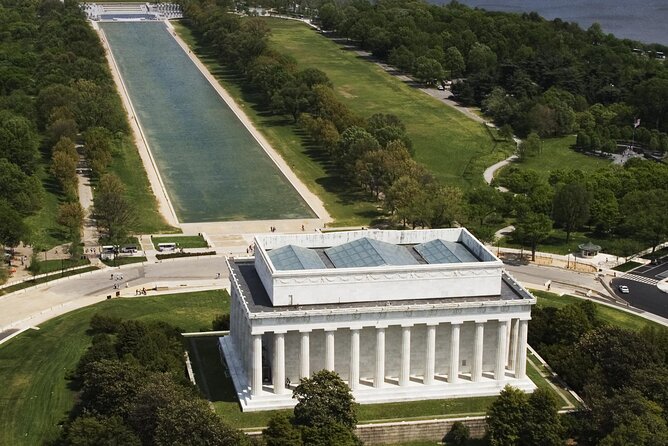
Then comes the Lincoln Memorial for 15 minutes. It’s listed as free and includes two helpful context points: it opened in 1922, and it’s a recognizable filming location from movies like Wedding Crashers and Forrest Gump. That makes Lincoln an easy stop for first-time visitors. You probably already know the place from pop culture, and the time block helps you turn that recognition into actual understanding.
The drawback here is emotional and interpretive depth. Memorials invite you to slow down and think. With the route’s time windows, you might have to do the thinking faster than you’d like. My advice is simple: pick one theme to focus on at each memorial. For example, choose FDR and WWII, Jefferson and his wide interests, or Lincoln and his role in national identity.
White House Views and the National Archives Finish Line
The White House stop is listed for 25 minutes, and it has the biggest “check your assumptions” factor. The address is 1600 Pennsylvania Avenue NW, and the description highlights it as the residence of presidents, with the note that every president lived there except George Washington.
What’s crucial is that the stop’s admission is listed as not included. So your time here should be planned as an exterior experience unless you’ve arranged entry separately. The extra 25 minutes compared with most other stops suggests there’s more time needed for positioning, photos, and simply enjoying the area around such a famous building.
Finally, the route ends at the National Archives Museum for 15 minutes. The key idea is straightforward: it’s the repository of some of the most important documents in United States history. Even if you only have a short window, the Archives stop gives the day a “papers and proof” finish. It’s a good contrast to the memorials, and it ties back to the Capitol theme at the start.
Because the experience ends back at the meeting point, the route feels like a loop rather than a one-way march. That helps if you’re mixing your DC sightseeing with other plans later, like grabbing food near your hotel or meeting friends.
Is This the Right Fit for Your DC Day?
I think this works best for you if:
- You want a low-cost, app-led way to see a lot of the Mall’s major landmarks.
- You like a plan with short stop times that helps you avoid spending half a day stuck in one place.
- Your priorities are landmarks and landmark-adjacent museums, not hours of slow exhibit reading.
I’d think twice before booking if:
- You need a live person to fix start-point confusion or app/ticket problems.
- You want to go inside everything and assume each stop’s entry is fully covered.
- You prefer long, relaxed museum time instead of a quick overview loop.
If you’re organized and you review the stop notes ahead of time, this can be a smart way to get your DC bearings fast. If you’re hoping for a guided experience with on-the-spot help, you may find the independence frustrating.
If you do book, treat it like a walking plan with time blocks. Use the included admissions to your advantage, but double-check what’s covered at the White House before you get there.
FAQ
How much does the tour cost?
It’s $5.00 per group (up to 15).
How long is the National Mall expedition?
It’s listed as approximately 1 to 3 hours.
Where does the tour start and end?
It starts at the United States Capitol (Washington, DC 20004, USA) and ends back at the meeting point.
What language is the app tour available in?
The experience is offered in English.
Is this tour private?
Yes. It’s private, and only your group participates.
Are admission tickets included?
Admission ticket details vary by stop. Many stops list admission ticket included, Lincoln Memorial is free, and the White House is listed as admission ticket not included.
Which stops are included on the route?
The route includes the U.S. Capitol, National Museum of the American Indian, National Air and Space Museum, Smithsonian Castle, Washington Monument, Franklin Delano Roosevelt Memorial, Thomas Jefferson Memorial, Lincoln Memorial, the White House, and the National Archives Museum.
Is the Lincoln Memorial stop free?
Yes. The Lincoln Memorial is listed with admission ticket free.
What are the operating hours?
It lists Monday through Sunday from 6:00 AM to 11:00 PM.
Can I cancel for a full refund?
Yes. Free cancellation is available up to 24 hours in advance for a full refund. If you cancel less than 24 hours before the start time, the amount paid is not refunded.