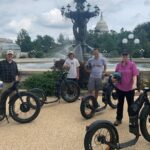
A scooter tour on the National Mall feels like cheating, in a good way. You’ll zip between landmark stops with a guide’s narration, so you spend less time waiting and more time seeing the main hits. This route runs past iconic monuments and memorials in a tight loop designed for efficiency.
Two things I really like: the guide team makes new riders feel comfortable, and the safety-first start matters a lot. In the reviews, Barry specifically is called out for checking on the whole group and letting first-timers get comfortable before rolling out. A second big plus is how much emotion and context you pack into about 2 hours 30 minutes, from major presidents to multiple war memorials.
One possible drawback: you’ll be moving most of the time, and the tour requires moderate physical fitness plus good weather. If you want very long, slow stays at each site, this format may feel fast.
In This Review
- Key highlights to know before you go
- A practical way to see the National Mall fast (without skipping the meaning)
- Meeting at 1012 14th St NW and what to expect from the group
- Lafayette Square and the White House viewpoint you can’t replicate later
- From Sherman’s monument to the Willard’s presidential-era stories
- Pershing Park to the World War I Memorial: a story in the center
- Smithsonian Castle and African American history stops that broaden the meaning
- Washington Monument: scale you feel more than you measure
- Tidal Basin and Thomas Jefferson: cherry-blossom timing matters
- A quick Pentagon sight and the MLK Memorial Bookstore stop
- Korean War Veterans and Lincoln: two different kinds of weight
- Vietnam Veterans Memorial and the Three Servicemen: where details do the talking
- World War II Memorial: stone architecture and bronze figures
- Price and value: is $137 a good deal for this format?
- Who should book this scooter tour
- Before you go: what to plan for on the day
- Should you book it?
- FAQ
- How long is the Public Group Scooter Tour of DC’s National Mall?
- How much does the tour cost?
- Where does the tour start, and when?
- Is the ticket digital?
- What age is required to join?
- Can I bring a pet or service animal?
- What if the weather is bad?
- What is the maximum group size?
Key highlights to know before you go
- Short, focused stops at the big names along the National Mall
- Barry-led safety prep that helps even zero-experience riders feel ready
- Free to view monuments along the route, so your money goes to guiding and time
- Tidal Basin and Jefferson-Lincoln area photo angles without heavy walking
- World War memorial variety, from WWI’s story panels to the Vietnam Wall names
- Small pets allowed with a proper backpack, plus service animals are allowed
A practical way to see the National Mall fast (without skipping the meaning)
The National Mall is one of those places where you can easily lose an entire day just moving between stops. This scooter tour solves that problem by keeping you in motion while still pausing enough to take in what matters. You’re not trying to sprint through history—you’re moving efficiently between landmarks, with narration that helps each stop make sense.
The biggest value for me is the balance: you get the visual wow (White House sightlines, Washington Monument scale, the stark Vietnam Wall) and you also get the human context. That makes the monuments feel less like postcards and more like places where real people were remembered on purpose.
You can also read our reviews of more shopping tours in Washington DC



Meeting at 1012 14th St NW and what to expect from the group
The tour starts at 1012 14th St NW in Washington, DC, and it returns to the same meeting point. Start time is 10:00 am, and the tour runs about 2 hours 30 minutes.
It’s capped at a maximum of 16 travelers, which helps keep the ride manageable and the stops from turning into a crowd-management headache. This is also a mobile-ticket tour, so you’re not worrying about paper vouchers in your pocket.
Also, there’s an age floor of 7 and up. That’s a useful detail if you’re traveling with kids, since you’ll know the ride pacing and safety expectations are set with that minimum in mind.
Lafayette Square and the White House viewpoint you can’t replicate later
Stop one is the White House, viewed from Lafayette Square on the north side. Even if you’ve seen it in photos a hundred times, the first sight can still pull you quiet. The building’s classic features—white exterior, tall columns, large windows—look especially crisp from the park-side viewpoint.
What I’d plan for here is the light and the fact that you’re not stuck behind the usual lines of a longer visit. You get a tight window (about 5 minutes) to take photos and orient yourself before moving on.
A small but nice detail: Lafayette Square’s manicured park grounds, statues, and trees create a more lived-in feel than a plain street view. From this angle, it’s easier to understand why this area is such a permanent Washington scene.
From Sherman’s monument to the Willard’s presidential-era stories
Next up is the William Tecumseh Sherman Monument, a bronze statue honored in 1903 and sculpted by Augustus Saint-Gaudens. This is a quick stop (about 5 minutes), but it adds a helpful layer: it reminds you that the Mall isn’t only about presidents—it’s also where commanders and national turning points get memorialized in metal and stone.
Then you’ll move through a cluster of historic context around the Willard InterContinental Hotel. Built in 1847, it’s described as a place that’s hosted presidents, served as a meeting spot for political figures, and even marked a milestone: the first telegraph message. During the Civil War era, it was a hub of activity, and later it’s also been connected to civil rights events.
This part of the tour helps if you tend to think of monuments as standalone stops. The Willard segment is a reminder that Washington’s political history lives not just in memorials but in the buildings where decisions and announcements happened.
Pershing Park to the World War I Memorial: a story in the center
The National World War I Memorial is in Pershing Park, and the centerpiece design is called A Soldier’s Journey. That idea is built into the memorial’s layout: it’s not only names and dates, but a narrative arc of leaving home, facing combat, losing comrades, and returning.
You get about 7 minutes here. That’s long enough to notice the sculptural storytelling and short enough that you’re not stuck waiting in a slow-moving crowd for the next group photo. For me, it’s one of the best “guided” stops because narration can tie what you’re seeing to why the memorial is shaped the way it is.
You can also read our reviews of more tours and experiences in Washington DC




Smithsonian Castle and African American history stops that broaden the meaning
After the war memorial, the tour includes stops connected to the Smithsonian complex—specifically the National Museum of African American History and Culture and the Smithsonian Castle.
Both are major anchors on the Mall, but they work differently. The museum is described as documenting African American life, history, and culture through artifacts like documents, photographs, and artworks. That means it’s not just a building you pass—it’s a dedicated space for records, context, and lived experience.
The Smithsonian Castle is the administrative center and its first Smithsonian building, designed by James Renwick Jr. It has the symbolism of being the institution’s original statement in architecture and purpose.
Because the tour format is a ride with short pauses, you shouldn’t expect a full museum visit during this time. Still, getting your bearings on where these major cultural stops sit can be valuable. It can also help you decide what you want to return to later for a longer, deeper look.
Washington Monument: scale you feel more than you measure
Stop four is the Washington Monument, built between 1848 and 1884 and designed by Robert Mills. It rises to an exact height of 555 feet 5 1/8 inches, which is one of those facts that sounds like trivia until you see the monument in person.
You’ll have about 7 minutes. That’s enough to take in the monument’s shape and to understand how the Mall’s open layout turns the view into a kind of natural framing device. If you’ve been wondering why the Mall feels so wide and ceremonial, the monument’s presence is part of the answer.
Tidal Basin and Thomas Jefferson: cherry-blossom timing matters
Next comes the Tidal Basin, described as about 107 acres and around 10 feet deep. It was built to use tides from the Potomac River to flush sediment in the Washington Channel. Even if you don’t care about water management as a topic, this detail makes the basin feel like engineered infrastructure, not just a pretty pond.
It’s also where the Cherry Blossom Festival is most famously associated, so spring timing can change the mood a lot—though this tour runs based on weather, not festival schedules.
Then you’ll stop at the Thomas Jefferson Memorial, built between 1939 and 1943. It’s neoclassical in style and includes Jefferson quotes meant to capture his ideology and philosophy, described as Jeffersonian democracy. You’ll get about 10 minutes here.
This stop is a good place for a quick mental reset. After wars and memorials, Jefferson gives you a political-philosophy angle. The narration helps connect what you see in stone to the ideas printed on the walls.
A quick Pentagon sight and the MLK Memorial Bookstore stop
After Jefferson, you’ll see the Pentagon from across the Potomac River. The description includes five concentric pentagonal rings, plus the idea that it’s one of the world’s most recognizable building shapes. This is more of a skyline-style viewpoint than a memorial moment—but it’s helpful because it ties the Mall’s commemorations to the present-day military headquarters.
Then the tour includes a stop at the Martin Luther King Jr. Memorial Bookstore. This memorial area honors MLK’s legacy and the struggle for freedom, equality, and justice. The description notes him as an advocate for racial equality and working-class and oppressed communities, both in the U.S. and around the world. You’ll have about 10 minutes here.
What makes this stop useful in a scooter format is simple: you get a respectful overview without having to plan a separate visit just to understand what the location is meant to represent.
Korean War Veterans and Lincoln: two different kinds of weight
The Korean War Veterans Memorial comes next, and you’ll have about 10 minutes. The inscription concept centers on honoring sons and daughters who answered a call to defend a country they never knew and people they never met. That phrasing matters because it frames the war’s distance and the personal sacrifice without turning it into abstract history.
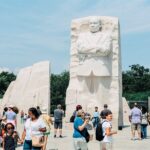
After that, you’ll reach the Lincoln Memorial with another about 10 minutes. Beneath the words about unity and saving the Union, you’ll see Abraham Lincoln seated in marble. Lincoln’s symbolism here is about strength and wisdom as a national memory.
I like pairing these two stops because they deliver different emotional messages. Korean War memorial language leans toward honoring service and distance; Lincoln’s presence works like a moral and national anchor.
Vietnam Veterans Memorial and the Three Servicemen: where details do the talking
Then the tour hits one of the most intense parts of the route: the Vietnam Veterans Memorial. It consists of two black granite walls engraved with the names of more than 58,000 Americans who died or remain missing, plus a bronze statue of three soldiers and a flagpole. You’ll have about 7 minutes.
If you’re the type who wants to skim, this is the kind of memorial that makes skimming feel wrong. The guide’s narration and the way the group moves through the space helps you find a rhythm—look, absorb, then move on without rushing the feeling.
Just before or alongside this, the route includes the Three Servicemen Statue, described as a bronze sculpture showing three soldiers representing different branches of the U.S. military. It’s a short stop (about 3 minutes), but it gives you a concrete visual bridge between branches and sacrifice, before the walls take over your attention.
World War II Memorial: stone architecture and bronze figures
The tour finishes with the World War II Memorial, where stone architecture and bronze sculptures recognize American service, honor those who fell, and reflect on victory tied to ending tyranny and restoring freedom. You’ll have about 10 minutes here.
This stop works well at the end because the route has already covered major war eras. By the time you reach WWII, you’re better prepared to notice the emotional pattern across the different memorial designs—each one handling remembrance in its own visual language.
Price and value: is $137 a good deal for this format?
The price is listed as $137.00 per group, up to 1. That wording suggests the cost is tied to your group size booking rather than splitting a large bill across a big party.
So where does the value come from? First, you’re paying for guided narration plus a structured route that saves time. Second, most of the stops here are admission free to view, and the tour format keeps you from spending half your day simply figuring out how to link all the major memorials together.
For $137, you’re basically buying:
- time efficiency across a dense area
- interpretation that makes monuments easier to understand quickly
- comfort and safety support for riding, especially for first-time scooter users
If your alternative is doing it on your own with lots of walking and searching, the guided scooter approach usually feels worth it fast. If you’re already a confident scooter rider who just wants a self-guided photo circuit, you might question the cost. But for most people, the narration and pacing are the reason to book.
Who should book this scooter tour
This tour is a strong match for you if:
- you want to see many major National Mall monuments in one morning
- you prefer a guided, narrated overview rather than reading everything on your own
- you’re new to scooters and want a guide who slows things down at the start
- you like a mix of landmark sightseeing and memorial context
It’s not the best fit if:
- you need long, unhurried time at each memorial for your own pace
- you’re traveling during poor weather or you’re unsure you can handle moving for most of the tour
Before you go: what to plan for on the day
A few practical notes to keep your ride smooth:
- You’ll want moderate physical fitness, since you’re scooting and stopping often over the tour’s 2.5-hour length.
- The tour requires good weather. If weather turns, it may be rescheduled or refunded.
- Service animals are allowed, and small pets can join if you use a proper backpack.
- The minimum age is 7 years old, so it’s set for older kids rather than toddlers.
If you’re a first-time rider, treat the beginning like practice time. The reviews highlight that Barry makes comfort and safety a priority before you head out.
Should you book it?
Yes, if you want a smart way to see the National Mall’s top memorials in one shot. The biggest reasons to book are the guided narration, the efficiency of the scooter format, and the fact that the guide (Barry) is specifically praised for helping first-timers feel safe and comfortable.
If you’re the type who wants to linger for long stretches at every wall and inscription, you may find the pace a touch brisk. In that case, you might use this as your orientation tour, then return on foot later to the places that hit hardest.
FAQ
How long is the Public Group Scooter Tour of DC’s National Mall?
The tour is approximately 2 hours 30 minutes.
How much does the tour cost?
The price is $137.00 per group (up to 1).
Where does the tour start, and when?
It starts at 1012 14th St NW, Washington, DC 20005, USA, and the start time is 10:00 am.
Is the ticket digital?
Yes, it uses a mobile ticket.
What age is required to join?
Only travelers 7 years old and above are allowed.
Can I bring a pet or service animal?
Service animals are allowed. Small pets may accompany you if you have a proper backpack.
What if the weather is bad?
The tour requires good weather. If it is canceled due to poor weather, you’ll be offered a different date or a full refund.
What is the maximum group size?
This tour/activity has a maximum of 16 travelers.