REVIEW · WASHINGTON DC
Washington DC Monuments and Memorials Night Tour
Book on Viator →Operated by Heart of DC Tours · Bookable on Viator
Night lights turn DC into a movie set. On this 3-hour small-group night tour (max 12), you’ll hop monument to monument when crowds thin out, and you get phone audio for each stop so you can understand what you’re seeing without rushing. I also like how the tour keeps you moving in an air-conditioned van, which matters when it’s cold enough that your fingers protest the camera app.
One thing to plan for: this is not a full “walk with the guide the entire time” style experience. The guide stays with the vehicle, and you’ll mostly explore on your own while using the audio link on your device (bring your own earbuds/headphones, since they’re not included).
In This Review
- Key highlights at a glance
- Why DC’s monuments look different after dark
- The 7:00 pm pickup and the pace that keeps you from freezing
- Thomas Jefferson Memorial and Ford’s Theatre: ideals, then iconic streetscape photos
- White House exterior photos from the best angles
- World War II, Iwo Jima, and MLK: three memorial messages in one arc
- Vietnam Veterans Memorial and the black granite effect
- Lincoln Memorial steps and the unity lesson
- Korean War memorials: quiet figures, mirrored granite, and short pauses
- U.S. Capitol exterior: the last photo stop that helps you picture the map
- Guide style in a 12-person van: Ken’s patient, practical touch
- What’s included, what’s not, and what to pack for a cold DC evening
- Price and value: is $89 worth it for 3 hours?
- Should you book this DC monuments night tour?
- FAQ
- Does the tour run for about 3 hours?
- What time does the tour start and where do we meet?
- How big is the group?
- What’s included in the price?
- Are earbuds or headphones included?
- Do we need tickets for the major stops?
- Is free cancellation available?
Key highlights at a glance
- Max 12 people means shorter lines to get in and more personal attention
- 7:00 pm start gives you that just-lit-up DC look for photos
- Phone audio at each site helps you follow the story while you’re standing there
- A comfy, weather-friendly van on winter nights (even when roads get icy)
- A full DC “big ideas” loop from Jefferson’s ideals to Lincoln, then through multiple war and civil-rights memorials
- Mostly free memorial stops keep your spending under control (White House and Capitol exterior are photo stops)
Why DC’s monuments look different after dark
Daytime DC is all about walking distances, crowds, and trying to remember where everything is. At night, the monuments feel more “arranged” and less like a checklist. You’re seeing marble, granite, and bronze in softer light, and that changes how each message lands.
This tour is built for that effect. You’re not stuck on one spot for hours. Instead, you roll between key areas and spend short, focused chunks of time at each memorial so you can actually take it in.
And since it’s a small group, the mood stays calm. You’ll still take pictures, but it doesn’t feel like you’re filming over someone’s shoulder every minute.
You can also read our reviews of more evening experiences in Washington DC

The 7:00 pm pickup and the pace that keeps you from freezing
You meet at One CityCenter, 850 10th St NW, and the tour starts at 7:00 pm. The whole experience runs about 3 hours and finishes back where you started.
The timing is practical: each stop is long enough for a photo, a short walk around, and a moment to read what matters. You’ll usually be out for roughly 10 to 20 minutes per location, then back into the van for a reposition.
There’s also a built-in comfort factor. You’re in an air-conditioned vehicle, which sounds funny for a night tour, but it helps on days when it’s chilly outside and you want to warm up fast between stops. One reason people rave about this tour in winter is that the van keeps things survivable when the sidewalks get slick or the wind cuts through.
Thomas Jefferson Memorial and Ford’s Theatre: ideals, then iconic streetscape photos
You start at the Thomas Jefferson Memorial by the Tidal Basin. The building is a neoclassical design inspired by the Pantheon in Rome, and it’s topped by a huge statue of Jefferson. Inside, you’ll see excerpts from his writings, which is a nice way to connect the architecture to the political ideas the memorial is built around.
Even if you’re not there for cherry blossoms, it’s worth knowing that the Tidal Basin area is often described as especially peaceful. That matters because Jefferson’s theme is about liberty and democracy, not just a statue photo.
From there, you move to Ford’s Theatre. It’s known for the striking red brick façade and ornate details. This is more of a street-level stop: you’ll want to step out, look up, and grab pictures of the building and its surroundings.
A quick reality check: at night, street lighting and angles can be hit-or-miss. If you’re the type who hates blurry night shots, bring a steady stance and consider how your camera phone handles low light.
White House exterior photos from the best angles
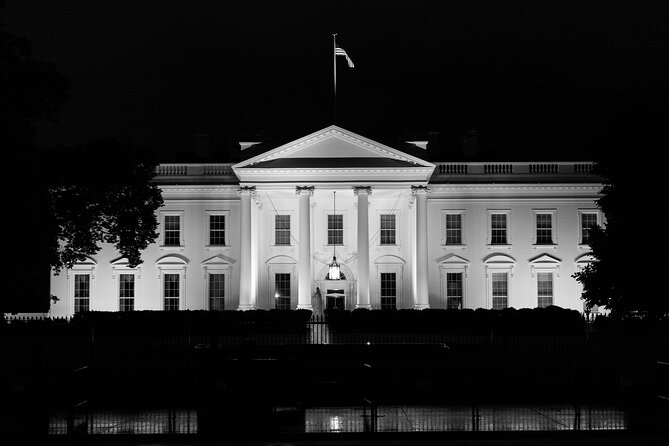
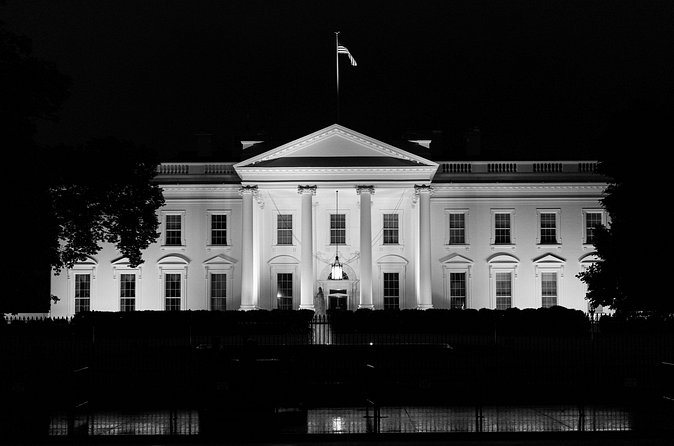
Next comes the White House. The tour focuses on outside viewing and photography, including the kind of angles you can get around the Ellipse area.
Plan on about 15 minutes here. That’s not a tour of the building, and it’s not meant to turn into a long wait. It’s a clean photo-and-stand-back moment: you get the scale, the symmetry, and those manicured grounds that frame the building.
Admission isn’t included for this stop, but you shouldn’t expect to need tickets for exterior viewing. Just know you’ll be doing what the name implies: photographing one of the most recognizable buildings on earth from the public areas around it.
If the weather is rough, stay flexible with your photo priorities. You’ll be on a schedule, and the van rides help you keep momentum without standing out in cold wind too long.
World War II, Iwo Jima, and MLK: three memorial messages in one arc
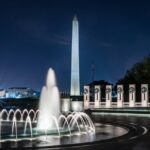
Then the emotional weight ramps up. The World War II Memorial is made for reflection: it features 56 pillars representing U.S. states and territories connected to the war, set around the Reflecting Pool and near the Lincoln Memorial.
The design is dramatic at night. Water features and lighting add movement, and the memorial’s size makes it feel more “public” and less like a private space. You’ll have around 15 minutes, which is enough for a careful look at key elements without turning it into a long sit-down.
After that you’ll visit the U.S. Marine Corps War Memorial, also called the Iwo Jima Memorial. The statue of the flag-raising is unmistakable. The surrounding park space makes it feel quieter than you might expect for something so famous, and it tends to read especially well once the lights come on.
Next is the Martin Luther King Jr. Memorial. You’ll see a 30-foot statue rising from granite, plus quotes integrated into the memorial grounds. It’s designed for walking and pausing, and you can feel the shift from war commemoration to civil-rights ideals.
If you like “meaningful in order,” this section works. It’s not random stops. It’s a sequence that moves from collective sacrifice to bravery to the ongoing fight for justice.



Vietnam Veterans Memorial and the black granite effect
The Vietnam Veterans Memorial is one of the most powerful memorial experiences in DC, and the pacing here respects that. You’ll have about 20 minutes.
The core feature is the black granite wall inscribed with over 58,000 names. The naming layout pulls you in, and at night that contrast—dark stone, bright reflections, steady lettering—can feel even sharper.
You can also see how the memorial area extends the story. Nearby are the Three Servicemen Statue and the Vietnam Women’s Memorial, which helps the experience feel less one-dimensional than you might expect from the wall alone.
One practical note: at night, surfaces can look slick or uneven even when they seem fine in daylight. Take your time around the edges, especially if you’re wearing slick shoes.
Lincoln Memorial steps and the unity lesson
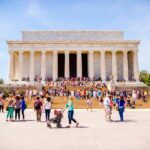
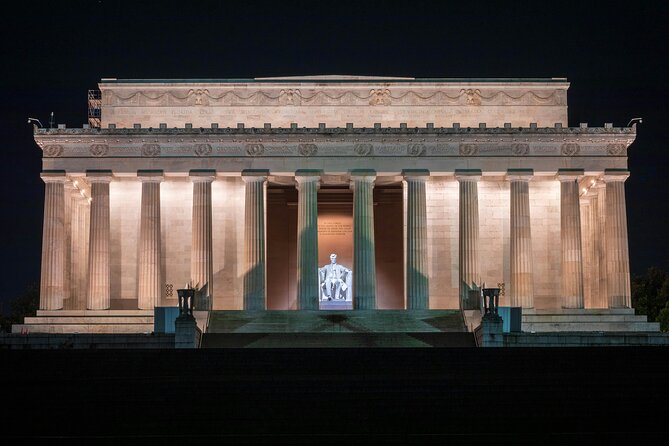
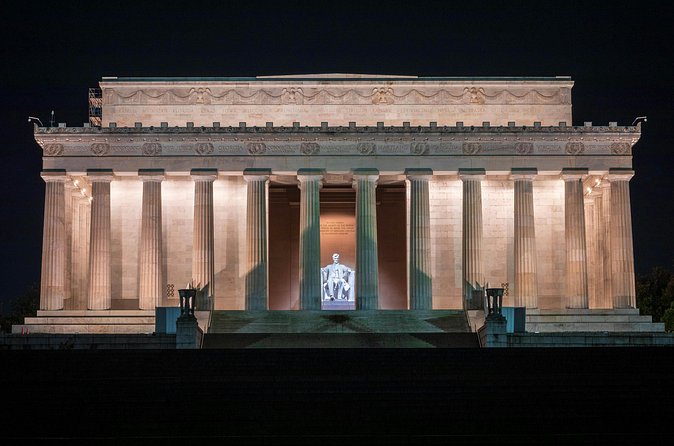
Then it’s on to the Lincoln Memorial. The tall statue of Abraham Lincoln anchors the scene, framed by classical architecture and 36 columns representing the states at the time of his death.
You’ll also see why this stop matters beyond photos: the steps are associated with Dr. King’s historic speech about civil rights. Even if you don’t memorize the exact words, standing there helps you connect the building to the broader arc of American history.
The tour gives you about 20 minutes here. That’s enough time to look up at the columns, walk around the front area, and decide whether you want to linger at the steps or prioritize photography.
The key value of doing Lincoln at night is contrast. The memorial isn’t just “important.” It’s visually grand, and at night it becomes a strong background for thinking about unity, freedom, and the cost of those ideals.
Korean War memorials: quiet figures, mirrored granite, and short pauses
Next is the Korean War Veterans Memorial. It uses 19 stainless steel statues of soldiers arranged in a way that feels observational rather than heroic-from-a-distance.
The setting includes a black granite wall that reflects their presence, with juniper bushes framing the space. The whole design invites quiet, not cheering.
You’ll have around 15 minutes. That’s a good length for this one. You’ll likely start at the main view, then do a slower second pass to catch how the figures relate to the wall’s reflections.
If you like memorials that don’t shout, this is the section that usually sticks with people. It reads as “human scale” even though it’s still a major DC site.
U.S. Capitol exterior: the last photo stop that helps you picture the map
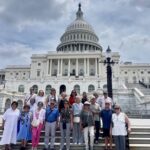
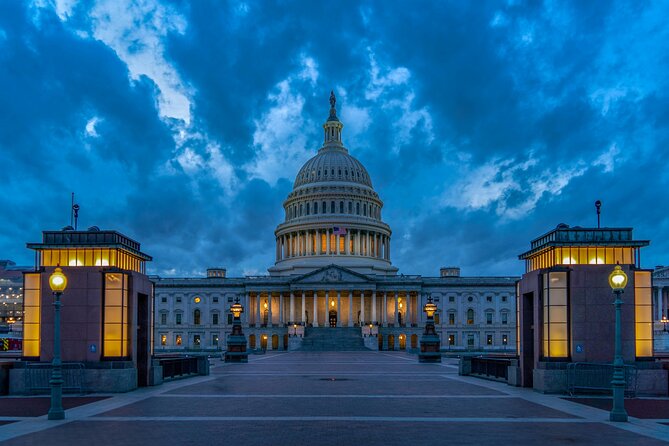
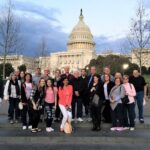
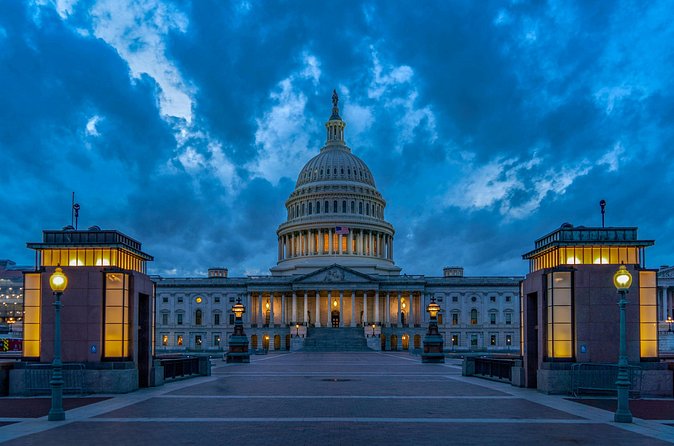
The final big landmark is the U.S. Capitol exterior, focusing on the west side and its architecture and dome. You’ll have about 10 minutes here.
Admission isn’t included, and that matches the goal. This is a photo-and-orientation stop so you leave the tour understanding how the city’s political center connects to the memorials you just saw.
If you’re planning a future daytime visit, this is the kind of stop that helps you map routes in your head. You’ll start recognizing sight lines, and that makes the rest of DC feel less like a puzzle.
Guide style in a 12-person van: Ken’s patient, practical touch
Most of the standout experiences in this tour come down to how the guide handles real life: weather, timing, mobility needs, and last-minute changes.
Ken is one of the guides you’ll often see leading this tour, and the pattern is consistent: clear commentary between stops, calm coordination, and real patience. One couple shared that he worked to rebook after a spouse got sick the night before, showing flexibility when travel doesn’t go perfectly. Another note described how he took extra care helping someone manage getting in and out of the van, which matters because the schedule assumes you can move at a steady pace.
There’s also a detail that can matter on cold nights: one person mentioned their guide provided flashlights, which is helpful if some monument areas don’t get great lighting. Even if that’s not always the case, it’s a good reminder to bring your own small flashlight if you’re sensitive to uneven footing at night.
What’s included, what’s not, and what to pack for a cold DC evening
This tour includes bottled water, an air-conditioned vehicle, and an audio link for each site. The audio is meant to complement what you hear from the guide, and it’s especially useful when you’re at a monument and want context while you look around.
What’s not included is important:
- WiFi on board is not provided
- Earbuds/headphones are not provided
So plan to bring your own earbuds or headphones. If you rely on phone audio, that’s the difference between quietly learning and standing there skipping the soundtrack.
Also pack for weather. This is a night tour where you’ll be outside for short windows at multiple memorials. Wear layers you can manage fast, and choose shoes with solid grip. Even on “just cold” nights, DC sidewalks can feel slick once it’s dark.
Price and value: is $89 worth it for 3 hours?
At $89 per person for about 3 hours, the value comes from three places.
First, you’re paying for transportation that keeps you comfortable and on schedule. DC distances are real, and walking a “big monuments” loop at night can turn into a cold endurance test fast.
Second, the tour is small-group. When the max is 12, you’re less likely to feel like you’re fighting for space at each stop.
Third, you’re getting meaning, not just movement. The audio links plus the guide’s commentary help you avoid the most common DC night problem: staring at monuments without knowing what you’re looking at.
There are also cost controls. Most sites on this route are free to enter, while the White House and the U.S. Capitol exterior are photo-style stops where ticket costs aren’t the point. So your biggest optional spending is usually just snacks or photos, not surprise entry fees.
If you’re a first-timer and want a fast orientation plus emotional context, the price tends to feel fair. If you already know every detail and only want photos, you might be able to DIY. But for most people, the guide + audio combo is what makes the money feel earned.
Should you book this DC monuments night tour?
If you want a first-night introduction to Washington’s major memorial themes—democracy, war sacrifice, civil rights, and national identity—this is a strong match. The short, structured stops help you see a lot without turning the experience into a grueling hike.
I’d especially recommend it if:
- You’re visiting for the first time and want your bearings fast
- You’ll be traveling in cold or winter weather and want vehicle comfort
- You like learning key ideas while you take photos
- You prefer a small group over the big-bus experience
I’d think twice if:
- You hate self-guided moments and want the guide physically walking with you at every stop
- You forget to bring earbuds/headphones, since the audio is a big part of how you get the context
- You’re hoping for long, slow time inside major buildings (this tour is mostly memorial-focused and photo-driven)
FAQ
Does the tour run for about 3 hours?
Yes. The tour duration is approximately 3 hours.
What time does the tour start and where do we meet?
The start time is 7:00 pm. You meet at One CityCenter, 850 10th St NW, Washington, DC 20001.
How big is the group?
The tour has a maximum of 12 travelers.
What’s included in the price?
The price includes bottled water, an air-conditioned vehicle, and an audio link for each site.
Are earbuds or headphones included?
No. Earbuds/headphones are not included, so plan to bring your own if you want to listen to the audio.
Do we need tickets for the major stops?
Many stops are listed as free for admission ticket access (including the Jefferson, World War II, Marine Corps, MLK, Vietnam Veterans, Lincoln, and Korean War memorials). The White House and U.S. Capitol exterior stop are listed as not included, meaning you shouldn’t count on admission/ticket coverage for those.
Is free cancellation available?
Yes. You can cancel for a full refund up to 24 hours before the experience start time.