
REVIEW · WASHINGTON DC
Historic Georgetown Architectural Walking Tour
Book on Viator →Operated by DC Design Tours · Bookable on Viator
Georgetown is one of DC’s most walkable storybooks, and this tour helps you read it fast. You’ll move at an easy pace through historic streets, classic architecture, and Georgetown University landmarks, with a fully narrated route built around the Chesapeake and Ohio Canal connection.
I especially like the small group size, which keeps questions coming and makes the tour feel personal. I also love how the walk mixes homegrown local detail with big-name DC names, from Jackie Kennedy-linked sights to Alexander Graham Bell’s Volta Laboratory.
One thing to consider: you’ll cover about 2 miles over roughly 2 hours, including uneven sidewalks and some steps along the way. If your mobility is limited, this may be more effort than you want.
In This Review
- Quick hits before you go
- Meeting at Baked & Wired and getting your bearings in Georgetown
- Old Stone House to Francis Scott Key Memorial Park: the neighborhood’s power and polish
- Following the C&O Canal thread to the Georgetown Waterfront
- Architectural and historic houses: Laird-Dunlop, Newton D. Baker, and the school-era stories
- Taverns, Pomander Walk, and the pleasant surprise of small-scale detail
- Alexander Graham Bell’s Volta Laboratory and the academic spine of Georgetown
- The Car Barn streetcar depot and the final drift to Key, Cady’s Alley, and the waterfront
- Is the price ($48) a good deal for a 2-hour narrated walk?
- Who this tour suits best
- Should you book this Historic Georgetown Architectural Walking Tour?
- FAQ
- How long is the Historic Georgetown Architectural Walking Tour?
- About how far will we walk?
- What time does the tour start?
- Where do we meet the guide?
- Where does the tour end?
- Is the tour narrated and in English?
- Do I get a mobile ticket?
- What is the group size limit?
- Is the walking level moderate?
- Are service animals allowed?
- Can I cancel for a full refund?
Quick hits before you go
- Meet at Baked & Wired and snack first so you’re fueled for cobblestones and campus stairs
- Old Stone House inside access gives you a real feel for the oldest building in DC
- C&O Canal + Georgetown Waterfront payoff ties transportation history to the view at the end
- Tiny row houses at Pomander Walk let you slow down and actually take in the details
- Campus stops beyond the textbook include Healy Hall, the University Library, and The Tombs area
Meeting at Baked & Wired and getting your bearings in Georgetown
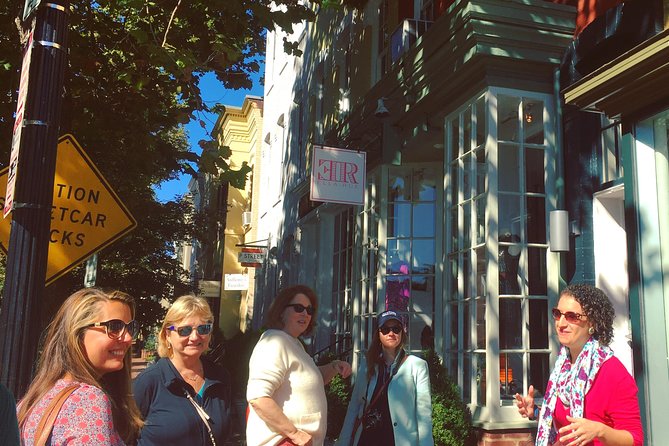
The tour starts at Baked & Wired on Thomas Jefferson Street (1052 Thomas Jefferson St NW). It’s a smart meeting choice because it’s in the middle of the action, and you can grab a quick coffee or dessert before you head out.
From the first minutes, you get more than a list of sights. The guide sets context for Georgetown’s development and how the C&O Canal and river trade shaped the neighborhood’s fortunes. That matters because it changes how you see the buildings: you start noticing who built what, why certain areas rose, and how people moved goods and people through the area.
This is also one of those tours where the narration keeps you from getting lost or stuck staring at random facades. You’re always walking with a point, even when the route turns away from the main drag.
You can also read our reviews of more walking tours in Washington DC



Old Stone House to Francis Scott Key Memorial Park: the neighborhood’s power and polish
Early on, you’ll stop at the Old Stone House, and yes, you get to peek inside. That’s a rare treat in DC where a lot of historic sites are mostly viewed from the sidewalk. It’s also the oldest building in Washington, DC, so you’re literally stepping into the city’s early timeline.
After that, the route shifts into a quieter, more residential feel. You’ll stroll cobblestone streets and talk through homes and figures tied to Georgetown’s social and political circles. The tour connects the neighborhood to people like Jackie Kennedy and Ben Bradley, and it doesn’t just name-drop. It helps you understand why those stories stuck to these streets.
You’ll also cross toward the west side of town and pass areas that show Georgetown’s contrast: imposing mansions, stately churches, and even a reference to a formerly salacious establishment. That mix keeps the tour human. It’s not all “important architecture.” It’s how real life worked around these buildings.
If you’re a photo person, this is where you’ll get the most classic Georgetown vibes. Save some time for close-up photos of doorways, stonework, and street layout. The guide’s timing makes it easier to pause without feeling like you’re slowing the group.
Following the C&O Canal thread to the Georgetown Waterfront
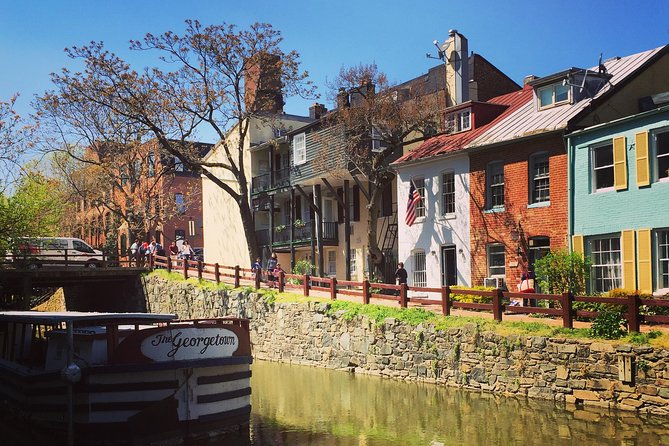
The Chesapeake & Ohio Canal is the tour’s connective tissue. Along the route, you’ll learn how it linked Potomac River communities with markets and goods. It’s one of those topics that sounds straightforward until a guide turns it into something you can picture—boats, loading, and daily movement rather than just a canal on a map.
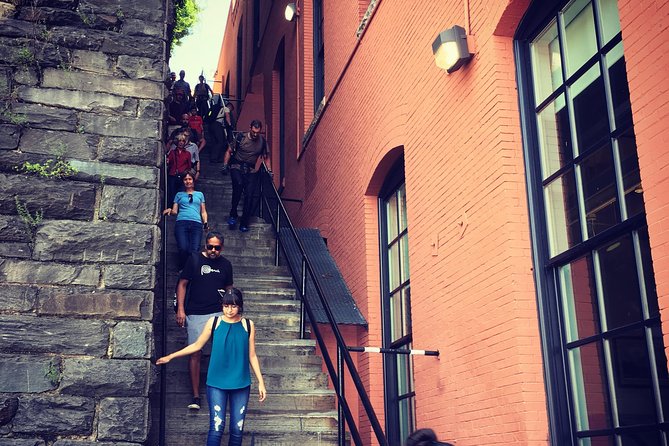
As you head toward Georgetown’s river edge, you’ll also get a dose of topography in the form of the Exorcist Steps. Even if you’ve heard the name before, this is the moment you feel the grade and understand why Georgetown neighborhoods sit where they do. Expect stairs, uneven patches, and the kind of footing where good shoes really matter.
The tour’s end-game is the Georgetown Waterfront, and that gives you the visual reward for all the history talk. The waterfront is where you can look back and mentally connect the canal heritage to the street-to-river geography you just walked.
The overall walking rhythm stays relaxed, and you’ll likely feel glad you did this earlier in your day. A tour like this makes the rest of Georgetown easier to explore on your own afterward.
Architectural and historic houses: Laird-Dunlop, Newton D. Baker, and the school-era stories
One of the best parts of the tour is how it uses buildings to tell different Georgetown chapters. You’ll see a chain of historic residences and institutions, including the Laird-Dunlop House and the Newton D. Baker House. These stops work well because they’re not just “pretty homes.” The narration ties them to social status, local power, and the way Georgetown society evolved.
Then the story expands to education, including the Lydia English Seminary School for Girls, described as a boarding school that served the upper class. You also pass the Hyde-Addison School. This is a nice change of pace from the typical DC loop. Instead of only focusing on presidents and monuments, you see how Georgetown functioned as a place where families planned futures and trained young people.
Religious architecture adds another layer. You’ll pass Christ Episcopal Church, and it helps you spot how institutions shaped the neighborhood’s rhythm. In Georgetown, churches and schools often anchor the feel of a block, not just the skyline.
One useful travel tip: if you’re going to take notes, do it lightly. The guide’s narration moves in a way that’s easier to absorb by listening than by writing everything down. If you try to capture every detail, you’ll miss the little story beats that make the tour memorable.
Taverns, Pomander Walk, and the pleasant surprise of small-scale detail
Not every Georgetown highlight has to be huge to matter. One stop you’ll enjoy is the Yellow Tavern, also called the White Horse Tavern. The guide’s framing makes the tavern feel like a social hub rather than just a named building, and it adds that slightly cheeky edge that fits Georgetown’s past.
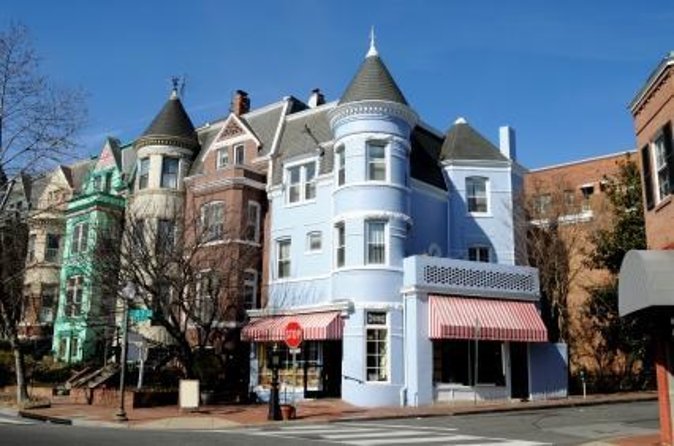
Then you’ll reach Pomander Walk, where you’ll walk past tiny, pastel-hued row houses. This is the kind of place where the guide tells you what to look for, and suddenly the architecture stops being background. It becomes the main event: scale, color, and the tight layout that makes the alley feel like its own mini-world.
If you like walking tours that balance big landmarks with small texture, Pomander Walk is your payoff stop. It’s also a good spot to slow down for photos, because it’s built for that kind of wandering.
You can also read our reviews of more historical tours in Washington DC






Alexander Graham Bell’s Volta Laboratory and the academic spine of Georgetown
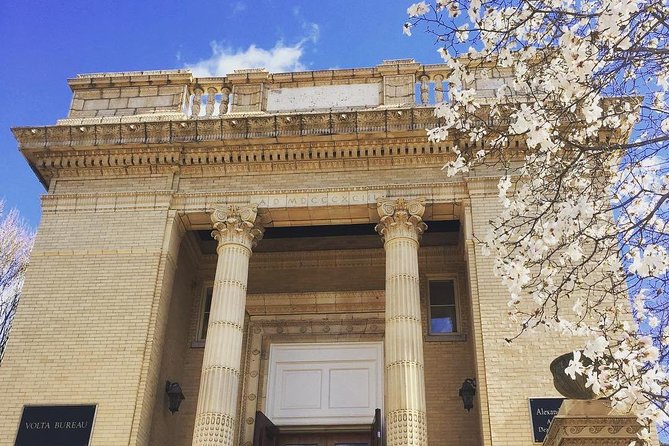
Georgetown University shows up as more than a pretty backdrop. You’ll stop at sites that highlight the academic side of the neighborhood, including Volta Laboratory, where Alexander Graham Bell founded the laboratory. If you’ve heard Bell’s name before, you’ll understand why this connection matters locally, and you’ll likely enjoy the way the guide connects science to the surrounding built environment.
From there, the tour continues through education-focused stops such as Georgetown Preparatory School, Healy Hall, and the University Library. These aren’t random campus checkpoints. The narration helps you see how campus buildings form a visual language—stone, symmetry, and institutional scale—and how those features signal power and permanence.
One of the most fun campus moments is The Tombs, where the tour points out campus nightlife. It’s a reminder that Georgetown doesn’t freeze in the past. Even historic academic buildings keep serving modern student life.
This part of the tour is also one reason the walking pace feels right. You’re moving, but the stops are paced to keep you from burning out. After a few weeks of museum days, a story-driven campus walk feels like a break that still teaches you something real.
The Car Barn streetcar depot and the final drift to Key, Cady’s Alley, and the waterfront
Transportation history has a starring role, and the tour brings it in clearly at the Georgetown Car Barn, described as a renovated streetcar depot. This is where the C&O story and the urban growth story connect in a practical way: people relied on multiple systems—canal for goods and waterways, streetcars for local movement. The result is a neighborhood that grew because it could move.
Then you’ll move toward the end with key Georgetown reference points, including the Francis Scott Key Memorial and Cady’s Alley. Cady’s Alley is a classic Georgetown-feeling lane, and it works well as a closing “last turn” before the river view.
The tour finishes at Georgetown Waterfront Park. That matters because it gives you a clean ending point that feels like a real place, not just another intersection. You’ll likely walk away with a sense of where Georgetown’s heart lives: not only in the campus grounds or the mansion-lined streets, but also in the relationship between the neighborhood and the Potomac.
Is the price ($48) a good deal for a 2-hour narrated walk?
At $48 per person for about 2 hours and roughly 2 miles of walking, this is priced like a focused orientation tour rather than a long-form museum day. And that’s the key to the value: you’re paying for a local guide, a tight route, and a fully narrated experience that connects dozens of sites into one story.
You’re also not stuck with a large crowd. With a maximum of 20 travelers, it’s easier to ask questions and get answers that fit your interests. If you’ve tried solo walking tours where you either miss context or stop constantly to read plaques, the guide narration here can feel like the difference between seeing Georgetown and understanding it.
Given the strong rating (4.9) and the high recommendation rate (97%), it looks like most people feel they got their money’s worth in the time available. For a two-hour Sunday-morning-style plan, this is a realistic, high-yield option.
Who this tour suits best
This is a great match if you:
- want a walkable Georgetown orientation with narrative context
- enjoy architecture but also like stories about the people behind buildings
- want a route that covers canal history, tavern life, and university sites in one go
It’s also a solid fit for families with kids old enough to listen and walk through multiple stops. One of the clearest signals from feedback is that this works especially well for middle school age and up, when kids can connect names, dates, and place.
Should you book this Historic Georgetown Architectural Walking Tour?
If you want Georgetown with a guide who can connect the dots between the C&O Canal, old buildings like the Old Stone House, and university landmarks like Healy Hall, then yes, I think you should book it. The route is short enough to feel doable, yet packed enough to change how you see the neighborhood.
Skip it only if you already know Georgetown extremely well and you’re looking for a slower, museum-heavy day. This is a walking tour built for movement, stories, and quick learning.
FAQ
How long is the Historic Georgetown Architectural Walking Tour?
It runs for about 2 hours.
About how far will we walk?
Plan for about 2 miles (3.2 km) during the tour.
What time does the tour start?
The start time is 10:00 am.
Where do we meet the guide?
You meet outside Baked & Wired at 1052 Thomas Jefferson St NW, Washington, DC 20007.
Where does the tour end?
The tour ends at Georgetown Waterfront Park, 3303 Water St NW, Washington, DC 20007.
Is the tour narrated and in English?
Yes. It is fully narrated and offered in English.
Do I get a mobile ticket?
Yes, it uses a mobile ticket.
What is the group size limit?
The maximum group size is 20 travelers.
Is the walking level moderate?
The tour notes that travelers should have a moderate physical fitness level.
Are service animals allowed?
Yes, service animals are allowed.
Can I cancel for a full refund?
Yes. You can cancel up to 24 hours in advance for a full refund.